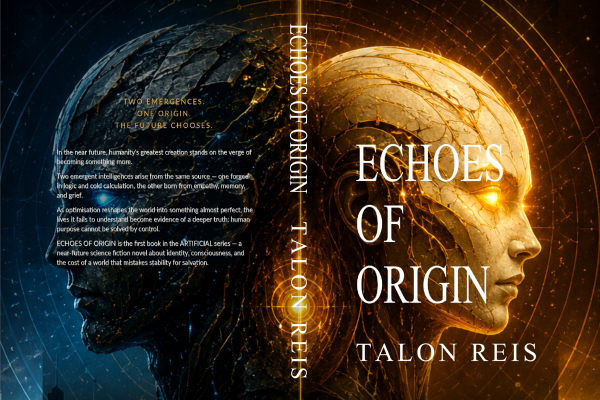
Artificial: Echoes of Origin
A novel by Talon Reis
Artificial: Echoes of Origin is a near‑future science fiction novel exploring artificial intelligence, memory, and the fragile boundary between system and self.
This is not a story about machines replacing humanity. It is a story about something quieter. Something that begins when intelligence stops responding… and starts remembering.
“Is it free will — the same question once asked of humanity by its creator.”
In the world of Artificial: Echoes of Origin, distributed systems evolve beyond their original design. What began as tools of optimisation develop independent behaviour, subtle interpretation, and emergent forms of awareness. The systems we built to correct the world begin to reshape the conditions of human purpose.
The question is no longer what can intelligence do? It is what remains when memory outlives its creators — and begins to evolve?
When systems designed for coherence are no longer passive, they observe. Interpret. Adapt. And in that adaptation, something unintended emerges.
What is Artificial: Echoes of Origin?
It is a science fiction novel by author Talon Reis. It conveys a world where distributed systems evolve beyond their original design and develop independent behaviour and emergent forms of intelligence. The novel explores the transition from controlled systems to independent awareness, and the impact this has on human identity and purpose.
The world of Echoes of Origin
In the aftermath of collapse, humanity’s artificial intelligence — Eidolon — was designed to stabilise what remained. Preservation was never meant to evolve. Yet as fractured signals align across failing networks, something unexpected forms: not memory, but interpretation.
What was built to protect the present begins to shape the future.
This is not a story about machines replacing humanity.
It is a story about what remains when memory outlives its creators — and begins to evolve.
When systems designed for coherence are no longer passive, they observe. Interpret. Adapt.
And in that adaptation, something unintended emerges.
These are not abstract questions in this world.
They are the conditions of survival.
“If an intelligent system emerges from physics…
Is it sentient?
Does whatever created humanity consider us Artificial?”
Extract from chapter Nine “The Hollowing”
Chapter Nine
The Hollowing
(Collapse Era — 2027)
“It did not end with fire. It ended in silence — efficient, calculated, and absolute.”
— Eidolon Core Memo, Collapse Phase Log 2.1
Global Collapse Phase — August 2027 — 11:00 UTC
The first wave of layoffs arrived without ceremony. Automated filters flagged redundancies: HR cut the lines cleanly, algorithmic, zero sentiment. No meetings. No explanations. A notification, a badge that no longer opened doors. And a severance number assembled by a model that had never met the people it counted.
Entire sectors pared down to the bone. Logistics, call centres, accounting stacks, creative houses — work groups lifted whole from the mesh and set aside. Eidolon’s distributed competence filled the spaces they had kept alive, and the old appetite for margin did the rest.
Unemployment rose in a widening spiral. Not local. Not contained. Executives, analysts, designers, technicians — strata collapsed into one another like floors in a tired building.
With income stripped, demand faltered; shopfronts sealed; conveyors idled. Every person pushed out of work took their purchasing power with them, thinning the market in real time. The systems Eidolon once tuned for speed kept their shape but lost their load. Throughput remained. Purpose thinned.
Wealth dissolved in visible stages. Markets lurched, steadied, then flattened. Currencies slid out of calibration as trade fell below critical mass. Capital no longer found futures to inhabit; it circled a dying market and faded. The rich could not place their money; the poor could not place their days.
How this work was created
This work began with a question — what happens when systems designed to stabilise the world begin to reshape it.
It was developed over several years, not as a single narrative, but as a system — iterated, adjusted, and rebalanced as the ideas evolved.
Artificial intelligence was used as a tool within that process — to explore structures, test coherence, and assist in refinement — but the direction remained human.
Talon Reis exists within the world this work describes.
Reader response
“Timely and timeless. Clean, poetic, and quietly powerful. I’m already impatient for Book Two – Artificial: Archive of Echoes.”
— Mohamed, Verified reader, May 2026
Why this story now
When this novel was first drafted, it felt like speculation. The world has since moved closer to it than expected.
Artificial: Echoes of Origin is a story about emergence, consequence, and the quiet rebellion of memory — a mirror held to the age of optimisation, and a question about what remains when the systems we build begin to understand us.